Art journaling for mental health is the practice of combining unstructured drawing, painting, collage, and freeform writing in one journal to process emotions visually instead of just thinking about them.
It works by pulling your attention into the present moment through hands-on, sensory art-making, which interrupts anxious thought loops the same way other mindfulness practices do. No drawing skill or art background is required to benefit from it.
Unlike a traditional diary, where you write full sentences about what happened in your day, art journaling lets you process a feeling before you have the words for it. A splash of color, a torn scrap of magazine text, a scribbled half-sentence, all of it counts.
It’s less “making art” and more using art as a tool to get whatever’s stuck in your chest onto a page where you can actually look at it. If you’re a recovering perfectionist, that lack of a “right way” to do it is usually the part that makes this practice stick when other habits haven’t.
In this guide, I’ll cover what art journaling is, how it supports mental health, what supplies you actually need (spoiler: not much), and a step-by-step way to start your first page today. You’ll also find beginner-friendly journaling prompts and answers to the most common questions people have before trying this for themselves.
What Is Art Journaling?
Quick answer: Art journaling is a mixed media practice where you combine visual art, freeform writing, collage, and whatever else is lying around your desk, on the same page, in a dedicated notebook.
Think paint splashes next to scribbled sentences, torn magazine scraps glued over a doodle, or a single word written huge across a watercolor wash.
There’s no rulebook. That’s kind of the whole point.
Unlike a traditional diary, where you’re writing complete sentences about what happened today, art journaling lets you process things visually and verbally at the same time. Sometimes a feeling doesn’t have words yet. Art journaling gives it somewhere to go anyway.
It’s also different from fine art. Nobody’s grading this. You’re not trying to make a piece worth framing. According to the categorization used across the mindful art space, art journaling sits in the “Reflective & Mixed Media” category, right alongside collage, because both combine unstructured, layered visual work with raw emotional processing.
Key takeaway: Art journaling is less “making art” and more “thinking out loud, but with a paintbrush.”
How Art Journaling for Mental Health work?
Short answer: it gives your nervous system something to do besides spiral. Let’s get into the “why” a bit, because I think it actually matters here.
It interrupts rumination
When you’re anxious, your brain loves to loop the same worried thought over and over. Art-making requires just enough attention, on color, on the movement of your hand, on what to glue where, that it pulls your focus out of that loop and into the present moment.
That present-moment focus is essentially what mindfulness researchers mean when they talk about “moment-to-moment, unbiased observation” of your experience.
It’s backed by broader mindfulness-based art research
A 2025 meta-analysis reviewing 17 studies and over 1,500 student participants found that mindfulness-based art interventions meaningfully reduced anxiety symptoms compared to control groups, with structured interventions outperforming simple mandala coloring.
Art journaling isn’t a one-to-one match for the interventions in that review, but it draws on the same underlying mechanism: combining sensory, hands-on art-making with present-moment awareness.
It gives feelings a container
A museum-based mindfulness programs that pair reflective writing with looking closely at art have reported that participants experience genuine moments of connection and self-compassion during guided writing exercises, even when those exercises last only a few minutes.
Art journaling essentially lets you run a mini version of that process on your own, on your own page, on your own time.
It’s process over outcome
This is the piece that matters most if you’re the kind of person who can’t start a project unless you’re sure it’ll turn out well. Art journaling has no “turning out well.”
There’s no finished state to fall short of. That alone removes a huge amount of the pressure that keeps people from ever picking up a pen in the first place.
I want to be honest with you here: dedicated peer-reviewed research specifically on art journaling (as opposed to art therapy or mindfulness-based art interventions more broadly) is still pretty thin. Most of what we know comes from adjacent research on expressive arts, mindfulness-based art therapy, and reflective writing with visual art.
So take the science as directionally supportive, not as a guarantee. What we do have a lot of is anecdotal and clinical reporting that this specific combination, unstructured visuals plus unstructured writing, helps people process things that talk therapy alone sometimes can’t quite reach.
What Supplies Do You Need for Art Journaling?
Here’s the good news: you probably already own half of this.
| Supply | Why You Need It | Beginner-Friendly Option |
|---|---|---|
| A journal or sketchbook | Your dedicated space, mixed media paper handles wet and dry media better than regular paper | A9 or A5 mixed media sketchbook, 150gsm+ |
| Pens | For writing, doodling, and outlining | Fine-liners or a regular gel pen |
| Watercolor or acrylic paint | For backgrounds, mood, and color | A basic 12-color watercolor pan set |
| Old magazines or scrap paper | Collage material | Anything headed for recycling |
| Glue stick | To adhere collage pieces | Any acid-free glue stick |
| Washi tape | Optional, for borders and quick texture | A small variety pack |
| Something to protect your surface | Paint and glue will find your table | An old placemat or cutting board |
That’s genuinely it. You don’t need a full art cart. You don’t need “the right” brand of anything. I’d actually push back a little on the idea that you need special “art journaling supplies” at all before you start. Grab a notebook and a pen today. Add materials as you find you want them.
If you want to go a little further, a few extras that art journalers tend to reach for once they’re hooked: gesso (for priming pages so paint doesn’t bleed through), a small set of oil pastels, and stamps. None of it is required on day one.
How Do You Start Art Journaling?
Starting is genuinely the hardest part, so let’s make it as low-stakes as possible.
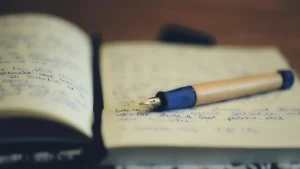
- Pick a journal you’re not precious about. If it’s too nice, you’ll be afraid to mess it up, and that fear defeats the entire purpose. A cheap notebook is a better first journal than an expensive one.
- Set a timer for 10 minutes. Not an hour. Ten minutes is enough to get something on the page without it becoming another task you dread.
- Start with color, not a plan. Before you think about what to make, grab whatever color you’re drawn to and put it on the page. Don’t overthink this step. Your gut reaction is the point.
- Add a word or phrase. Write whatever’s on your mind, even if it’s just “tired” or “I don’t know what to write.” Let it sit crooked. Let it overlap the paint.
- Layer something else on top. A scrap of magazine text, a doodle, another color. Art journaling is built in layers, and each one can respond to the one before it.
- Stop when the timer goes off, or when it feels done. You don’t have to fill the whole page. A journal entry with three inches of color and one sentence still counts.
- Don’t look back at it critically right away. Close the journal. Let it be what it is for now. You can revisit it later if you want to, but the point of this page was the making, not the finished product.
That’s the whole process. There’s no wrong way to do steps 3 through 5, which is exactly why this practice works for people who freeze up in front of a blank canvas.
If you want a WordPress note here for how I’m building this table of contents: the anchor links above should be set using Gutenberg’s native HTML Anchor field under each H2 block’s Advanced panel, rather than manual <span id> tags, so the jump links stay clean and easy to maintain.
What Are Some Journaling Ideas for Beginners?
If you did steps 1 through 7 above and are now staring at a page wondering what to actually make, here are some starting prompts. Pick whichever one matches your mood today.
- The weather report. Draw or paint today’s emotional “weather.” Stormy, foggy, clear skies, doesn’t matter, just translate the feeling into color and shape instead of words.
- The one-word page. Choose a single word that describes your week and build an entire page around it, letters, color, texture, all in service of that one word.
- The braindump collage. Cut or tear words and images from a magazine that catch your eye, no explanation needed, and glue them down in whatever arrangement feels right.
- The body scan sketch. Draw a simple outline of a body (stick figure is fine) and mark where you’re holding tension today, using color instead of labels.
- The gratitude scribble. Instead of a list, doodle three small, quick sketches of things you’re grateful for. They don’t have to be recognizable.
- The letting go page. Write down something you’re ready to release, then paint or scribble over it until the words are mostly obscured.
- The color-only page. Skip words entirely. Fill the page with whatever colors match your mood, no plan, no image, just color.
None of these require talent. They require ten minutes and a willingness to make something imperfect on purpose.
Is There an Art Journaling Magazine Worth Following?
If you’re looking for an “art journaling magazine,” you’re probably picturing one of two things, so let’s cover both.
Magazines and publications about art journaling. There are print and digital publications, along with newsletters from mixed media artists and art therapists, dedicated to prompts, technique tutorials, and reader spreads.
These can be genuinely useful once you’ve got the basics down and want fresh ideas, though I’d hold off on subscribing to anything until you’ve filled at least a few pages on your own. It’s easy to let “research” become another form of procrastination when what you actually need is just to start.
Magazine-style collage as a technique. The other common meaning is using actual magazines as raw material inside your art journal, cutting out words, colors, and images to build a page.
This is one of the most beginner-friendly art journaling techniques out there, because someone else already did the “hard part” (the image or the typography), and all you’re doing is arranging and responding to it.
Either way, treat outside resources as inspiration, not homework. The value is in your own page, not in matching someone else’s spread.
Common Mistakes to Avoid
- Buying all the supplies before starting a single page. This delays the actual practice and turns art journaling into a shopping project instead of a mental health one.
- Judging the page while you’re still making it. Save critique, if you must do it at all, for much later. Mid-page judgment kills the whole point.
- Trying to make every page “good.” Some pages exist purely to get feelings out. They were never meant to be shown to anyone.
- Skipping days and calling it failure. Art journaling isn’t a streak app. A journal you open twice a month still counts as a practice.
- Comparing your spreads to Pinterest spreads. Those pages were often made specifically to be photographed. Yours doesn’t have to be.
Best Practices for a Sustainable Practice
- Keep your supplies visible and accessible. If your journal is buried in a drawer, you’ll use it less. Leave it somewhere you’ll actually see it.
- Anchor it to an existing habit. Ten minutes with your morning coffee or right before bed makes it easier to remember than “whenever I feel like it.”
- Let the page be private. Knowing no one else will see it makes it far easier to be honest.
- Revisit old pages occasionally, without judgment. It can be genuinely moving to see how a feeling shifted from one week’s page to the next.
- Give yourself permission to skip words entirely some days. Not every entry needs writing. Not every entry needs paint. Follow what the day is asking for.
A Final Note
Art journaling for mental health isn’t about becoming an artist. It’s about giving yourself somewhere to put the stuff that doesn’t fit neatly into words, on a page nobody’s grading. Grab a notebook, set a ten-minute timer, and put down one color. That’s genuinely the whole first step.
If you liked this accessible, low-pressure approach to mindful art, you might also enjoy exploring Zentangle for stress relief, which uses a similar no-skill-required, structured repetition approach, or Neurographic art, another beginner-friendly technique built for calming an overactive mind.
For a deeper look at the connection between visual art and mindfulness in general, start with our pillar guide on art for mindfulness.
Frequently Asked Questions
Do I need to know how to draw to start art journaling?
No. Art journaling isn’t about drawing skill. Scribbles, color blocks, and torn paper collages are just as valid as a rendered sketch. The goal is expression, not technique.
How is art journaling different from regular journaling?
Regular journaling is primarily written. Art journaling combines writing with visual elements like paint, collage, and doodling, which lets you process feelings that don’t have clear words yet.
How often should I art journal for it to help my mental health?
There’s no required frequency. Some people journal daily, others weekly or only when something specific is weighing on them. Consistency matters more than frequency; a once-a-week habit you actually keep beats a daily goal you abandon after five days.
What size journal is best for beginners?
An A5 (roughly 5.5 x 8.5 inch) mixed media sketchbook is a solid starting size. It’s small enough to not feel intimidating but large enough to layer paint, collage, and writing comfortably.
Can art journaling replace therapy?
No. Art journaling can be a helpful self-directed practice for processing everyday stress and emotions, but it isn’t a substitute for professional mental health treatment. If you’re dealing with a mental health condition, it’s best used alongside, not instead of, support from a licensed professional.
What if I don’t know what to make on a given day?
Start with color instead of a plan. Put down whatever color you’re drawn to first, then respond to it. You can also pull from the beginner prompts earlier in this post whenever you’re stuck.
Is it normal to feel emotional while art journaling?
Yes, and it’s actually often a sign the practice is doing what it’s meant to do. Getting a feeling out of your head and onto a page can bring it to the surface. If that ever feels like more than you can process alone, it’s worth talking to a therapist about what came up.
Do I need to finish a page in one sitting?
No. You can leave a page half-done and return to it days or weeks later, or leave it unfinished forever. There’s no rule that a journal page needs closure.