Your Archetypal Constellation
These are the unconscious patterns guiding your present moment:
Discover all 7 Classical Female Archetypes (Jungian Foundation)
Which ones are most present in you moment?
Table of Contents
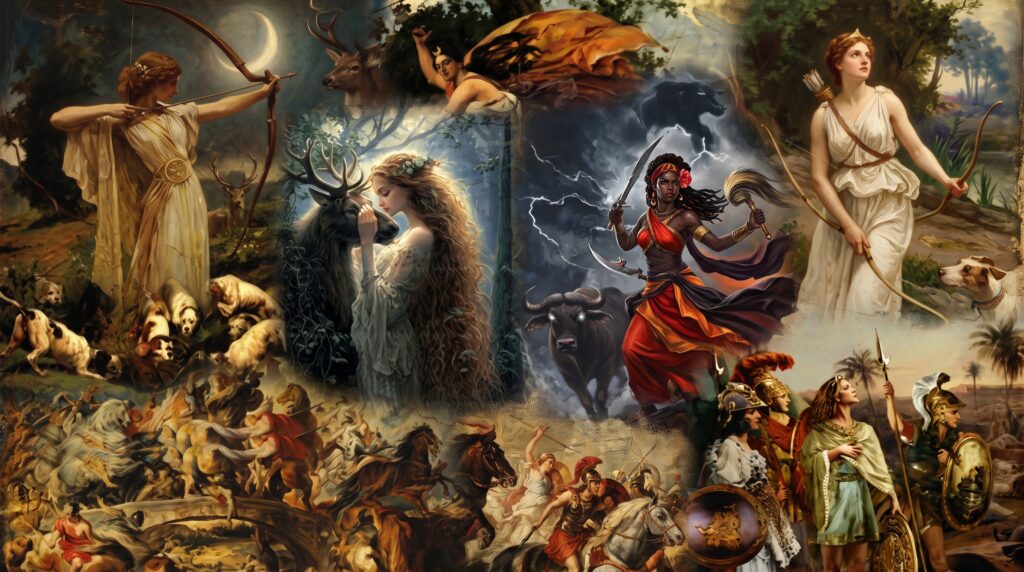
The Huntress / Wild Sister (Artemis)
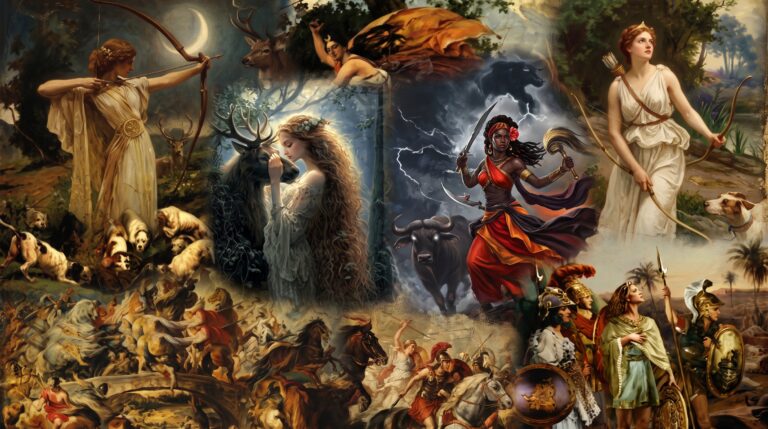
Primarily developed by psychiatrist Jean Shinoda Bolen (Goddesses in Everywoman) and structurally mapped earlier by Toni Wolff as the Amazon—Artemis personifies the autonomous, self-directed, and instinctual feminine consciousness.
The Meaning of “Virgin” (Virgo):
In depth psychology, the concept of the “Virgin Goddess” does not imply sexual abstinence or innocence. As Marion Woodman and Jean Shinoda Bolen emphasize, virgo originally meant “one-in-herself”—an individual who is psychologically whole, self-contained, and not defined through a relationship with a counterpart, husband, or father. While relational archetypes (like Hera or Demeter) draw their core identity from their connection to an external other (husband, child), Artemis is intact, self-motivated, and inwardly sovereign.
Core Drive & Values:
Unerring Aim & Focus: Artemis embodies goal orientation. When a woman is animated by this archetype, she possesses an archer’s focus: she picks a target (a career milestone, creative endeavor, social cause, or personal standard of fitness) and pursues it with relentless clarity, unimpeded by external expectations.
Sisterhood & Egalitarian Kinship (The Wild Sister): Artemis moves in the company of women and defends the vulnerable. In contemporary life, this reflects female camaraderie, advocacy for marginalized groups, solidarity, and collaborative non-hierarchical spaces.
Somatic Vitality & The Wild Wilderness: Artemis belongs to the forest, not the domestic hearth or the civic court. Psychologically, she reconnects a woman to her biological rhythms, bodily stamina, outdoor nature, and instinctual discernment.
The Polarities: Gift and Shadow
The Conscious Gift: Total psychological freedom, unapologetic boundaries, healthy detachment from people-pleasing conditioning, self-reliance, physical vitality, and deep solidarity with sisters and nature.
The Shadow / Archetypal Inflation:
Contempt for Vulnerability: When Artemis takes total control of the ego, she may despise softness, dependency, or grief—both in herself and in others.
Ruthless Coldness / Emotional Armor: Crossing her boundaries can trigger severe emotional freezing or vindictive severance (echoing the myth of Actaeon, who was transformed into a stag and torn apart by his own hounds after seeing Artemis naked).
Chronic Self-Sufficiency: Resistance to intimacy, relational commitments, or acknowledging genuine needs for closeness.
The Wild Sister Across Diverse Cultures Throughout History
The archetype of The Huntress / Wild Sister, formulated in Jean Shinoda Bolen’s goddess psychology through the classical Greek figure of Artemis and structurally rooted in Toni Wolff’s Amazon form, is not confined to classical Hellas. This same psychological dynamic—autonomy, kinship with untamed nature, laser-sharp focus, and resistance to relational domestication—reverberates across diverse cultures throughout history:
1. Greco-Roman Tradition
Artemis (Classical Greece): The virgin goddess of wild forests, untamed beasts, and mountains, armed with a bow and golden arrows. In analytical psychology, the archaic concept of the virgin (virgo) does not denote moral celibacy, but rather the woman who is “one-in-herself”—psychologically self-contained and not defined by her role as a wife or mother.
Diana (Ancient Rome): Her Italic and Roman counterpart, worshipped in sacred groves (such as at Nemi, on the shores of Lake Speculum). She preserves the attribute of the mistress of the wilderness (domina silvarum) and protector of feminine transitions and childbirth.
Atalanta (Greek Mythology): The mortal heroine and huntress consecrated to Artemis. Famous for defeating suitors in footraces and fiercely defending her autonomy until overcome by the golden apples of Aphrodite, she symbolizes the feminine drive that refuses premature submission to conventional matrimonial arrangements.
2. Celtic and British Traditions
Flidais (Irish Mythology): Goddess of wild herds, forests, and the hunt. Much like Artemis, she traveled in a chariot drawn by stags and safeguarded the instinctual balance of the woodland realm.
Scáthach (Ulster Cycle, Ireland): The legendary warrior woman and martial arts master dwelling on the Isle of Shadows. She personifies the austere mentor, independent of courtly ties, who trains heroes in martial discipline and unerring aim.
Andraste (Romano-Celtic Britain): The warrior goddess invoked by Queen Boudica during the uprising against Rome. She represents the ferocious, untamable aspect of territorial sovereignty resisting outside invasion.
3. Norse and Germanic Traditions
Skadi (Norse Mythology): Giantess and goddess of winter, snow-covered mountains, skiing, and bow-hunting. She rejected life in Njord’s coastal palace because she could not bear the separation from the high peaks and the din of the harbor, preferring the howling of wolves in her rugged wilderness. She embodies a visceral drive for psychological and geographic independence.
4. Yoruba and Afro-Atlantic Traditions
Iansã / Oya: Sovereign of winds, storms, and lightning; a huntress and warrior who wields the sword alongside male orishas. She embodies the passion for mobility, fearlessness, and a refusal to bow to patriarchal subjugation.
Obá: Goddess of turbulent waters, associated with hand-to-hand combat and courage in battle—a warrior companion who never shies away from direct confrontation.
5. Indigenous Traditions of the Americas
Pachamama (Central Andes): While predominantly embodying the Earth Mother, she displays strict attributes as the inviolable guardian of peaks and indigenous wildlife, demanding absolute respect for ecological and psychic boundaries.
Sedna (Inuit Mythology): Sovereign of the marine depths and Arctic sea mammals. Her narrative of isolation and initial refusal of ordinary suitors reflects the archaic psyche’s resistance to colonization by standard social expectations.
The Strategist / Sovereign Mind (Athena)
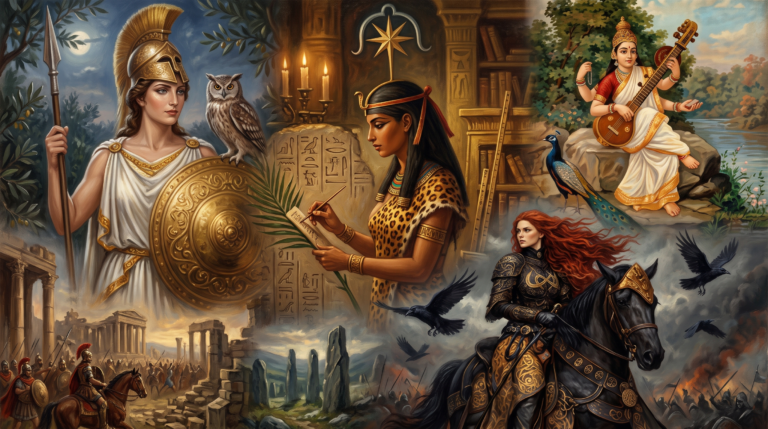
Within post-Jungian depth psychology, especially developed by psychiatrist Jean Shinoda Bolen (Goddesses in Everywoman) and structurally mapped in classical Jungian thought by Toni Wolff’s Amazon and C.G. Jung’s examination of the Animus / Logos principle, Athena embodies practical intellect, strategic foresight, emotional containment, and civilizing will.
In classical Greek myth, Athena (Roman Minerva) sprang fully grown and armored from the forehead of Zeus after he swallowed the Titaness Metis (Wisdom).
The Virginity of the Sovereign Mind (One-in-Herself):
Like Artemis, Athena belongs to the triad of Virgin Goddesses. In depth psychology, this indicates that her identity and sense of purpose are not derived from being a wife or a mother. While Artemis’s virginity is lived in the wilderness and instinctual nature, Athena’s virginity is lived in the polis (the civilized city, institutions, and statecraft). She is autonomous, self-sufficient, and invulnerable to romantic infatuation or emotional possession.
Core Drive & Mental Matrix
- Strategic Discernment & The “Right Moment” (Kairos): Athena is not a god of reckless, bloodthirsty battle (which belonged to Ares); she governs tactical combat, defense, planning, diplomacy, and justice. She assesses every situation with objective detachment, weighing long-term consequences and remaining calm under acute stress.
- Mastery of Craft, Technology, and Applied Wisdom (Techne): Beyond martial strategy, Athena is the patroness of weaving, architecture, pot-making, navigation, and state institutions. Psychologically, this represents the sublimation of raw psychic energy into concrete cultural form, functional systems, and disciplined execution.
- Father’s Daughter & Structural Alliances: Born without a mother’s gestation, Athena naturally operates with ease inside patriarchal structures, hierarchies, and male-dominated councils. She acts as a counselor, mentor, and strategist to kings and heroes (such as Odysseus, Perseus, and Achilles), defending order, contracts, and civil law.
The Polarities: Conscious Gift and Unconscious Shadow
The Conscious Gift: Unflinching clarity, emotional composure, strategic foresight, civic integrity, diplomatic competence, and the ability to execute long-range goals within complex organizations without being derailed by interpersonal drama.
The Shadow / Archetypal Inflation:
Loss of Somatic Connection: Complete alienation from bodily instincts, somatic fatigue, and vulnerabilities; she may live entirely “in her head.”
Contempt for the Irrational and Vulnerable: Disdain for tears, emotional messiness, grief, or chaotic feelings, regarding them as weakness or incompetence.
Ruthless System Compliance: Serving existing power structures or institutions with cold efficiency while ignoring humanitarian, empathic, or ethical soul-needs (the classic Medusa wound — turning feeling and instinct into stone).
In contemporary society, women are heavily conditioned to operate through an over-identified Athena persona, organizing, planning, competing, and suppressing vulnerability. In a percentage-based quiz, discovering a dominant Athena score (e.g., 40%-50%) alongside a silenced Aphrodite or Demeter (0%) provides immediate clinical insight into why a woman is suffering from chronic exhaustion, somatic numbness, and emotional dryness.
Across Cultures and Time: How This Archetype Has Been Called and Represented
Across civilizations and mythic traditions, the matrix of the Sovereign Mind, disciplined strategic warfare, justice, and master craftsmanship has appeared under various sacred names:
Minerva (Roman Religion): The Roman equivalent of Athena, revered on the Capitoline Triad alongside Jupiter and Juno. Minerva emphasized wisdom, civic laws, trade guilds, weaving, and the practical application of medicine and the sciences.
Saraswati (Vedic & Hindu Tradition): The goddess of knowledge, speech, wisdom, the arts, and intellect (Buddhi). Depicted with sacred scriptures and playing the veena, she embodies discriminative consciousness and cultural arts, standing free from maternal or domestic servitude.
Seshat (Ancient Egypt): The goddess of wisdom, writing, architecture, mathematics, surveying, and records. Depicted with a star-symbol above her head, she measured the foundations of temples and governed the cosmic order of structural building alongside Thoth.
Brigid / Brigantia (Celtic Tradition): In her aspect as the triple goddess of crafts, smithing, poetry, and law. She ruled the transformation of raw metal into armor and tools through disciplined craft and the protection of tribal sovereignty.
Neith (Pre-dynastic & Pharaonic Egypt): The primordial huntress and warrior goddess of Sais, considered the creatrix of the cosmos and master of weaving who spun the fabric of the world. The Greeks themselves directly equated Neith with Athena.
Morrígan (in her Macha aspect, Celtic Myth): While the Morrígan as a whole embodies raw battle-fury and sovereignty, her manifestation as Macha governs political sovereignty, strategic counsel to kings, foresight, and the defense of the realm’s civic borders.
Sophia / Sapientia (Hellenistic Gnosticism & Classical Philosophy): The personification of divine wisdom, discriminative understanding, and cosmic ordering, celebrated in wisdom literature (Proverbs, Wisdom of Solomon) as the architect standing beside the Creator at the foundation of the world.
The Hearth Keeper / Centered Mystic (Hestia)
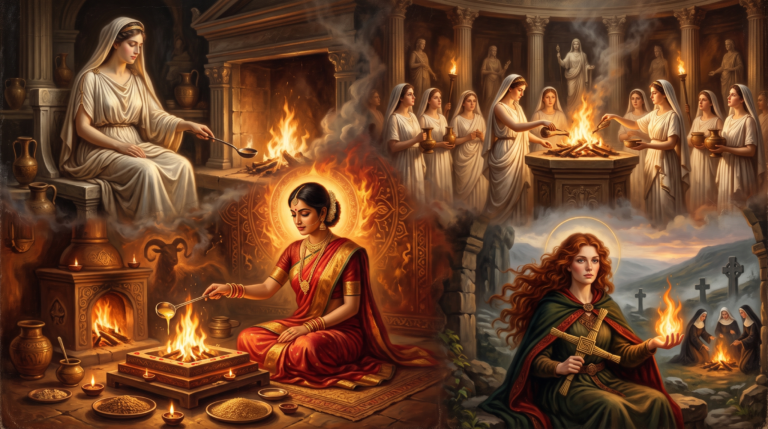
In classical Greek myth, Hestia (Roman Vesta) was the firstborn child of Cronus and Rhea, the goddess of the hearth fire, the sacred altar at the center of the home, and the civic prytaneum. When both Apollo and Poseidon sought her hand in marriage, Hestia touched the head of Zeus and took an inviolable oath to remain forever intact.
In post-Jungian depth psychology—established systematically in Jean Shinoda Bolen’s Goddesses in Everywoman and rooted directly in C.G. Jung’s foundational formulations of introversion, psychic energy, and the Self—Hestia completes the triad of the Virgin Goddesses alongside Artemis and Athena:
The Virginity of the Inner Sanctuary (One-in-Herself):
Like Artemis and Athena, Hestia is structurally non-relational: her identity, self-worth, and psychic libido do not depend on being the counterpart of a husband, a father, or a child. While Artemis lives this autonomy in wild nature and Athena in civic affairs, Hestia embodies virgin autonomy as pure interiority, psychological sanctuary, and self-containment.
The Non-Anthropomorphic Image and the Central Hearth:
Unlike the other Olympian deities, Hestia was rarely depicted in human form, painted on pottery, or dragged into dramatic Olympian power struggles. Her presence was experienced purely as the living, sacred flame burning at the circular center of the home and the city. Psychologically, this absence of personal drama represents a non-reactive, non-projecting ego posture: Hestia is the motionless axis around which the chaos of daily life revolves.
Deep Introversion and the Mandalic Self (Selbst):
Hestia embodies the inward movement of psychic energy (deep introversion and contemplative stillness). She tends the hearth not as domestic drudgery, but as a silent liturgy of ordering outer space to reflect inner equilibrium. In Jung’s structural mapping in The Archetypes and the Collective Unconscious (CW 9/1), she represents the steady, unshakeable center of the Self that preserves inner unity against ego fragmentation.
When consciousness is threatened by chaos, the psyche spontaneously generates circular and mandalic symbols to establish a sacred enclosure (temenos) and protect the center. The flame at the center of the circular hearth is the living mythological archetype of this centering drive. A high Hestia percentage indicates an active phase of psychic incubation, where a woman withdraws outer projections to tend her inner core.
The Polarities: Conscious Gift and Unconscious Shadow
The Conscious Gift:
Unshakeable inner serenity, grounded presence in the moment, capacity to thrive in solitude without loneliness, absolute detachment from the worldly race for status or external validation, and the instinctual gift to turn any physical dwelling into a sacred sanctuary.
The Shadow / Archetypal Inflation:
- Social Invisibility & Apathy: Severe withdrawal from worldly life, causing atrophy of social adaptation and avoidance of necessary external conflicts.
- Emotional Coolness: Appearing untouchable, detached, or numb when loved ones require emotional engagement or passionate involvement.
Paralysis of Action: Complete suppression of the assertive or aggressive instincts needed to fight for practical milestones or establish outward boundaries.
Across Cultures and Time: How This Archetype Has Been Called and Represented
Across mythological and religious traditions, the sacred keeper of the central flame, domestic order, and contemplative inwardness has appeared under various names:
Vesta and the Vestal Virgins (Ancient Rome): The direct Roman counterpart of Hestia, Vesta held supreme civic and religious significance. The Vestal Virgins tended the eternal sacred flame in her circular temple, ensuring the spiritual survival of Rome. If the flame went out, it was treated as an ominous national catastrophe, reflecting the psychological necessity of keeping the inner fire of psychic vitality burning.
Brigid / Saint Brigid (Celtic Tradition & Irish Christianity): In her aspect as keeper of the sacred flame and the domestic hearth at Kildare. Originally nineteen priestesses tended a perpetual sacred fire; with Christianization, she was syncretized as Saint Brigid, whose monastic community maintained the sacred flame that warmed and sheltered travelers and the community.
Agni-Patni and the Household Hearth (Vedic & Hindu Tradition): While Agni is the divine fire of cosmic ritual, the household domestic fire (Garhapatya) represents the spiritual anchor of family life and cosmic order (Rta). Tending this flame is a sacred domestic liturgy that sanctifies the home and purifies the daily atmosphere.
Zao Jun / The Hearth Mother (Chinese Domestic Religion & Taoism): The domestic spirit residing in the family hearth and kitchen. The deity observes the moral harmony and quiet conduct of the home, acting as the mystic mediator between domestic reality and celestial order.
Kamuy Fuchi (Ainu Tradition of Northern Japan): The primal goddess of the hearth and fire. Residing in the central hearth of every dwelling, she is the supreme judge of deeds, protector of the household, and the bridge between human life and ancestor spirits; profaning her hearth fire or ashes with disrespect or noise is strictly forbidden.
Chantico (Aztec / Mexica Mythology): The goddess of the personal hearth, domestic fire, and volcanic heat. She fiercely protects the intimate dwelling and the inner concentrated fire from outside violation.